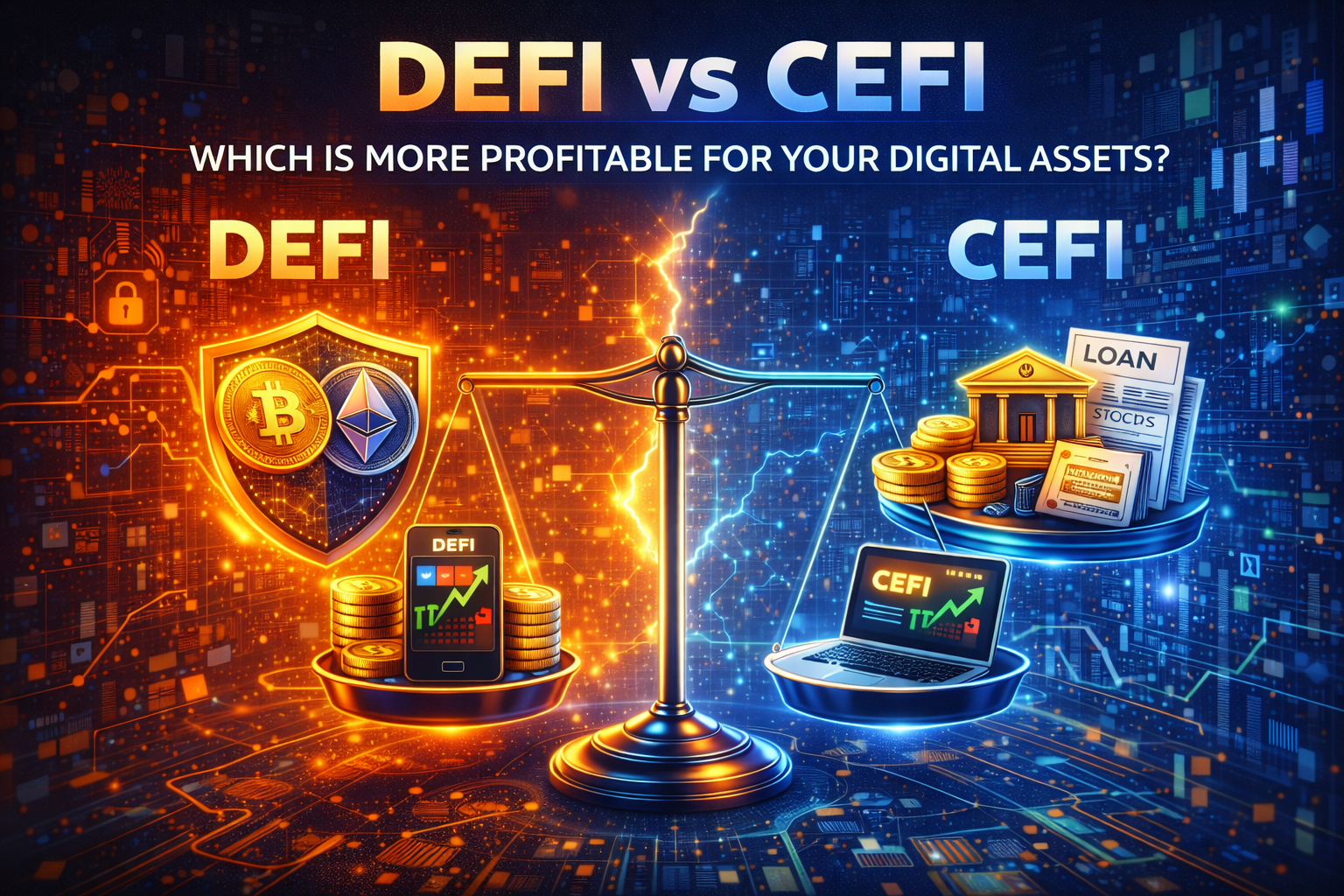
The cryptocurrency ecosystem has expanded far beyond simple peer-to-peer payments. Today, investors can choose between two major financial models to manage and grow their digital assets: Decentralized Finance (DeFi) and Centralized Finance (CeFi). Each approach offers distinct advantages, risks, and profit opportunities, making the choice between them a critical decision for crypto users.
Understanding how DeFi and CeFi work, and how they differ in terms of profitability, security, and accessibility, is essential for anyone looking to optimize returns on digital assets.
Understanding DeFi: Finance Without Intermediaries
Decentralized Finance, or DeFi, refers to a collection of financial applications built on blockchain networks that operate without centralized intermediaries. Instead of banks or financial institutions, DeFi relies on smart contracts—self-executing code that automatically enforces rules and transactions.
Common DeFi services include lending and borrowing platforms, decentralized exchanges (DEXs), yield farming protocols, and liquidity pools. Users maintain full control over their funds by connecting personal wallets directly to these platforms.
One of DeFi’s most attractive features is permissionless access. Anyone with an internet connection and a crypto wallet can participate, regardless of location or banking status.
Understanding CeFi: Traditional Structure in a Digital World
Centralized Finance, or CeFi, refers to crypto services provided by centralized platforms such as exchanges, lending services, and custodial wallets. These platforms act as intermediaries, managing user funds and facilitating transactions.
CeFi platforms typically offer user-friendly interfaces, customer support, and regulatory compliance. Services often include crypto trading, staking, interest-bearing accounts, and fiat on-ramps.
For many users, CeFi serves as the entry point into crypto due to its simplicity and familiarity.
Profit Opportunities in DeFi
DeFi is often associated with higher potential returns. Yield farming, liquidity provision, and staking can offer attractive annual percentage yields (APYs), especially during periods of high demand or protocol growth.
DeFi protocols distribute rewards through native tokens, providing users with both income and potential capital appreciation. Early adopters of successful protocols have historically achieved significant returns.
Additionally, DeFi allows composability, meaning users can stack multiple strategies—such as lending assets, borrowing against them, and reinvesting—to maximize profitability.
However, higher returns usually come with higher risks.
Profit Opportunities in CeFi
CeFi platforms generally offer more stable and predictable returns. Interest rates on savings accounts or staking products are typically lower than DeFi yields, but they are often more consistent.
Many CeFi platforms also provide fixed-term products with guaranteed returns, appealing to investors seeking income without constant management. Promotions, loyalty programs, and institutional-grade trading tools can further enhance profitability.
For users who prioritize convenience and risk management, CeFi offers a more controlled environment.
Risk Factors: The Cost of Profitability
When evaluating profitability, risk must be considered alongside returns.
In DeFi, smart contract vulnerabilities pose a significant risk. Bugs or exploits can lead to loss of funds, sometimes within minutes. Rug pulls and malicious projects further increase risk, especially in less established protocols.
Market volatility can also impact DeFi strategies. High yields may be offset by declining token prices or impermanent loss in liquidity pools.
CeFi risks are different. Users must trust platforms to manage funds responsibly. Exchange hacks, insolvency, or regulatory shutdowns can result in frozen or lost assets. While some platforms offer insurance or compensation mechanisms, these are not always guaranteed.
Control and Ownership of Assets
A key philosophical difference between DeFi and CeFi lies in asset ownership.
DeFi users retain full custody of their assets at all times. This aligns with the original principles of cryptocurrency—financial sovereignty and self-custody. Profitability is achieved without relinquishing control.
In contrast, CeFi requires users to deposit funds into platform-controlled wallets. While this simplifies operations, it introduces counterparty risk. Profits are earned at the cost of partial control.
For investors who value autonomy, DeFi may be more appealing despite higher complexity.
Accessibility and User Experience
CeFi excels in accessibility. Platforms are designed for ease of use, often resembling traditional banking or trading apps. Customer support, educational resources, and compliance features make CeFi suitable for beginners.
DeFi, on the other hand, has a steeper learning curve. Users must understand wallets, gas fees, blockchain networks, and security practices. Mistakes can be costly, as transactions are irreversible.
However, as DeFi interfaces improve and educational resources expand, this gap is gradually narrowing.
Regulation and Compliance Considerations
Regulation plays an increasingly important role in determining profitability and risk.
CeFi platforms are more exposed to regulatory changes. While regulation can enhance trust and stability, it may also limit access to certain products or impose restrictions that affect returns.
DeFi operates in a more decentralized and global environment. While this reduces regulatory friction, it also creates uncertainty regarding future compliance requirements.
Investors should consider how regulatory developments may impact both models in the long term.
Hybrid Strategies: Combining DeFi and CeFi
For many investors, the most profitable approach is not choosing one model over the other, but combining both.
CeFi can serve as a base for fiat access, stable returns, and ease of use, while DeFi offers higher-risk, higher-reward opportunities. Using CeFi for onboarding and DeFi for advanced strategies allows investors to balance profitability and risk.
Diversification across both systems reduces exposure to any single point of failure.
Long-Term Profitability: Which Wins?
There is no universal answer to whether DeFi or CeFi is more profitable. Profitability depends on market conditions, user expertise, risk tolerance, and investment goals.
DeFi tends to reward active users who are willing to research protocols, manage risk, and adapt quickly. CeFi suits investors seeking passive income, simplicity, and regulatory reassurance.
As the crypto ecosystem matures, the line between DeFi and CeFi may continue to blur, with hybrid platforms offering the best of both worlds.
Conclusion: Choosing the Right Path for Your Assets
DeFi and CeFi represent two distinct approaches to digital finance, each with unique strengths and limitations. DeFi offers autonomy, innovation, and potentially higher returns, while CeFi provides structure, ease of use, and stability.
For investors seeking maximum profitability, understanding both systems is essential. Rather than viewing DeFi and CeFi as competitors, they can be seen as complementary tools in a diversified crypto strategy.
Ultimately, the most profitable option is the one that aligns with your knowledge, risk tolerance, and long-term vision for your digital assets.
Deja una respuesta