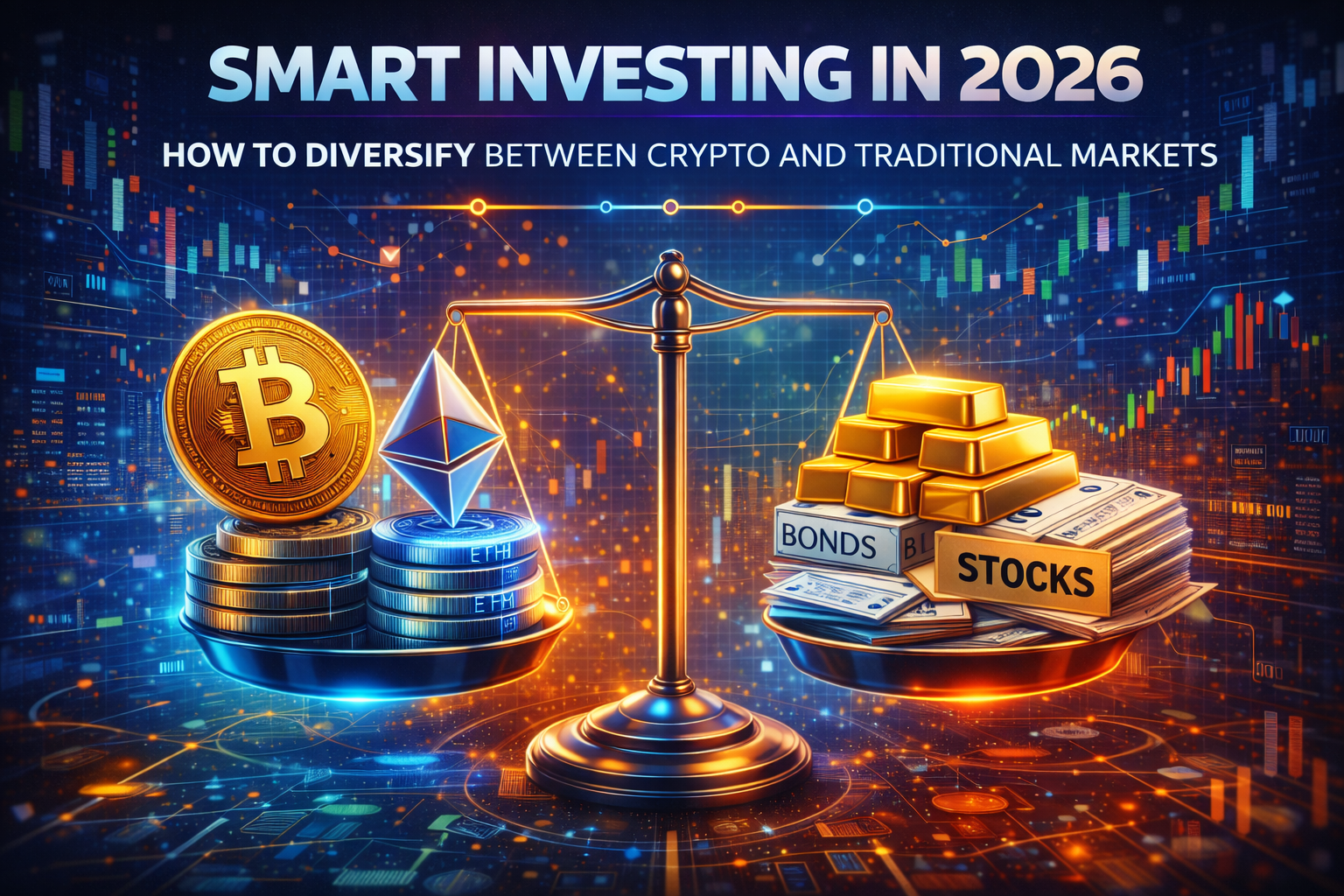
As global financial markets continue to evolve, 2026 is shaping up to be a pivotal year for investors seeking balanced, resilient portfolios. The rapid growth of cryptocurrencies, combined with ongoing shifts in traditional markets such as stocks, bonds, and commodities, has changed how diversification is approached. No longer is diversification limited to equities and fixed income; digital assets now play an increasingly important role in modern investment strategies.
Smart investing in 2026 requires understanding how crypto and traditional assets can complement each other, managing risk effectively, and adapting to an environment shaped by technology, regulation, and macroeconomic uncertainty.
Why Diversification Matters More Than Ever
Diversification has always been a cornerstone of sound investing. By spreading capital across different asset classes, investors aim to reduce risk while maintaining long-term growth potential. However, the financial landscape of 2026 presents unique challenges: persistent inflation concerns, evolving monetary policies, geopolitical uncertainty, and rapid technological disruption.
Cryptocurrencies introduce a new dimension to diversification. While they are more volatile than traditional assets, they also offer exposure to innovation, decentralized finance, and alternative value systems that are not directly tied to central banks or corporate earnings.
A well-constructed portfolio in 2026 recognizes that no single asset class consistently outperforms under all conditions.
The Role of Traditional Markets in a Modern Portfolio
Traditional markets remain the foundation for most investment strategies. Stocks, bonds, real estate, and commodities continue to offer stability, income generation, and long-term appreciation.
Equities provide exposure to corporate growth and innovation, particularly in sectors such as technology, healthcare, and renewable energy. Bonds, while offering lower returns, contribute stability and predictable income, especially during periods of market stress. Commodities like gold and energy assets can act as hedges against inflation and geopolitical risks.
In 2026, many investors are focusing on quality assets—companies with strong balance sheets, sustainable business models, and global reach. These characteristics help portfolios withstand economic cycles and market volatility.
Crypto as a Growth and Innovation Asset
Cryptocurrencies bring a different value proposition. Assets such as Bitcoin, Ethereum, and select altcoins offer exposure to blockchain technology, decentralized applications, and digital financial infrastructure.
Bitcoin is often viewed as a digital store of value, sometimes compared to gold due to its fixed supply and decentralized nature. Ethereum and other smart contract platforms represent innovation layers, enabling decentralized finance, tokenization, and digital identity systems.
While crypto markets are volatile, they are also driven by long-term adoption trends rather than traditional corporate performance. This makes them particularly valuable for diversification, as their price movements may not always correlate with stocks or bonds.
Balancing Risk Between Crypto and Traditional Assets
One of the most important aspects of diversification is risk management. Cryptocurrencies can deliver significant returns, but they can also experience sharp drawdowns. As a result, allocation size matters.
In 2026, many financial advisors suggest allocating a modest percentage of a portfolio to crypto—enough to benefit from upside potential without jeopardizing overall stability. The exact allocation depends on individual risk tolerance, investment horizon, and financial goals.
Younger investors with longer time horizons may allocate a higher percentage to growth-oriented assets like crypto and equities, while more conservative investors may prioritize income-generating and defensive assets.
Using Stablecoins as a Bridge Between Markets
Stablecoins play an increasingly important role in diversified portfolios. Pegged to fiat currencies, they offer price stability while maintaining blockchain-based efficiency.
In 2026, stablecoins are widely used for liquidity management, cross-border transfers, and yield-generating strategies within decentralized finance. They allow investors to move quickly between crypto and traditional opportunities without exposure to extreme volatility.
For example, stablecoins can serve as a temporary safe haven during market downturns or as a tool to earn passive income through low-risk lending platforms.
Correlation and Market Cycles
Understanding correlation between asset classes is essential for effective diversification. During periods of economic stress, traditional assets such as equities and crypto may move in the same direction, reducing diversification benefits.
However, over longer timeframes, crypto and traditional markets often follow different cycles driven by adoption trends, technological upgrades, and regulatory developments. This cyclical behavior can enhance portfolio resilience when allocations are adjusted strategically.
Rebalancing periodically—selling assets that have outperformed and reallocating to underweighted positions—helps maintain diversification and manage risk.
Regulation and Institutional Influence
By 2026, regulation plays a larger role in shaping both crypto and traditional markets. Clearer regulatory frameworks have increased institutional participation in digital assets, improving liquidity and reducing some systemic risks.
At the same time, regulation has reinforced the importance of compliance, transparency, and due diligence. Investors must stay informed about evolving rules, tax implications, and reporting requirements across asset classes.
Institutional involvement has also blurred the line between crypto and traditional finance, with tokenized stocks, bonds, and real-world assets becoming more common.
Technology and Access to Markets
Advancements in technology have democratized access to both crypto and traditional investments. Fractional shares, automated investment platforms, and decentralized protocols allow investors to build diversified portfolios with lower capital requirements.
In 2026, artificial intelligence and data analytics help investors analyze market trends, optimize allocations, and manage risk more efficiently. However, technology should complement—not replace—fundamental research and disciplined decision-making.
Common Mistakes to Avoid
One common mistake is overexposure to a single asset class due to hype or short-term performance. Chasing returns often leads to poor timing and increased risk.
Another mistake is neglecting traditional assets in favor of crypto or vice versa. True diversification requires balance, not extremes. Investors should also avoid neglecting liquidity needs, tax planning, and long-term goals when allocating capital.
Emotional decision-making remains one of the biggest threats to successful investing, especially in volatile markets.
Conclusion: Building a Resilient Portfolio for 2026
Smart investing in 2026 is not about choosing between crypto and traditional markets—it is about understanding how both can work together. A diversified portfolio that combines innovation-driven digital assets with stable, income-generating traditional investments is better positioned to navigate uncertainty.
Crypto offers growth potential and exposure to transformative technology, while traditional markets provide structure, reliability, and long-term wealth preservation. When managed thoughtfully, this combination allows investors to pursue opportunity without sacrificing stability.
Ultimately, diversification is not a one-time decision but an ongoing process. By staying informed, managing risk, and maintaining discipline, investors can build portfolios designed not just to survive market cycles, but to thrive in the evolving financial landscape of 2026 and beyond.
Deja una respuesta