As the cryptocurrency market continues to evolve, investors are increasingly looking beyond Bitcoin and Ethereum in search of higher growth opportunities. Altcoins—alternative cryptocurrencies to Bitcoin—often offer innovative technologies, niche use cases, and, in some cases, stronger upside potential during favorable market conditions. While higher returns usually come with higher risk, identifying projects with strong fundamentals can significantly improve long-term outcomes.
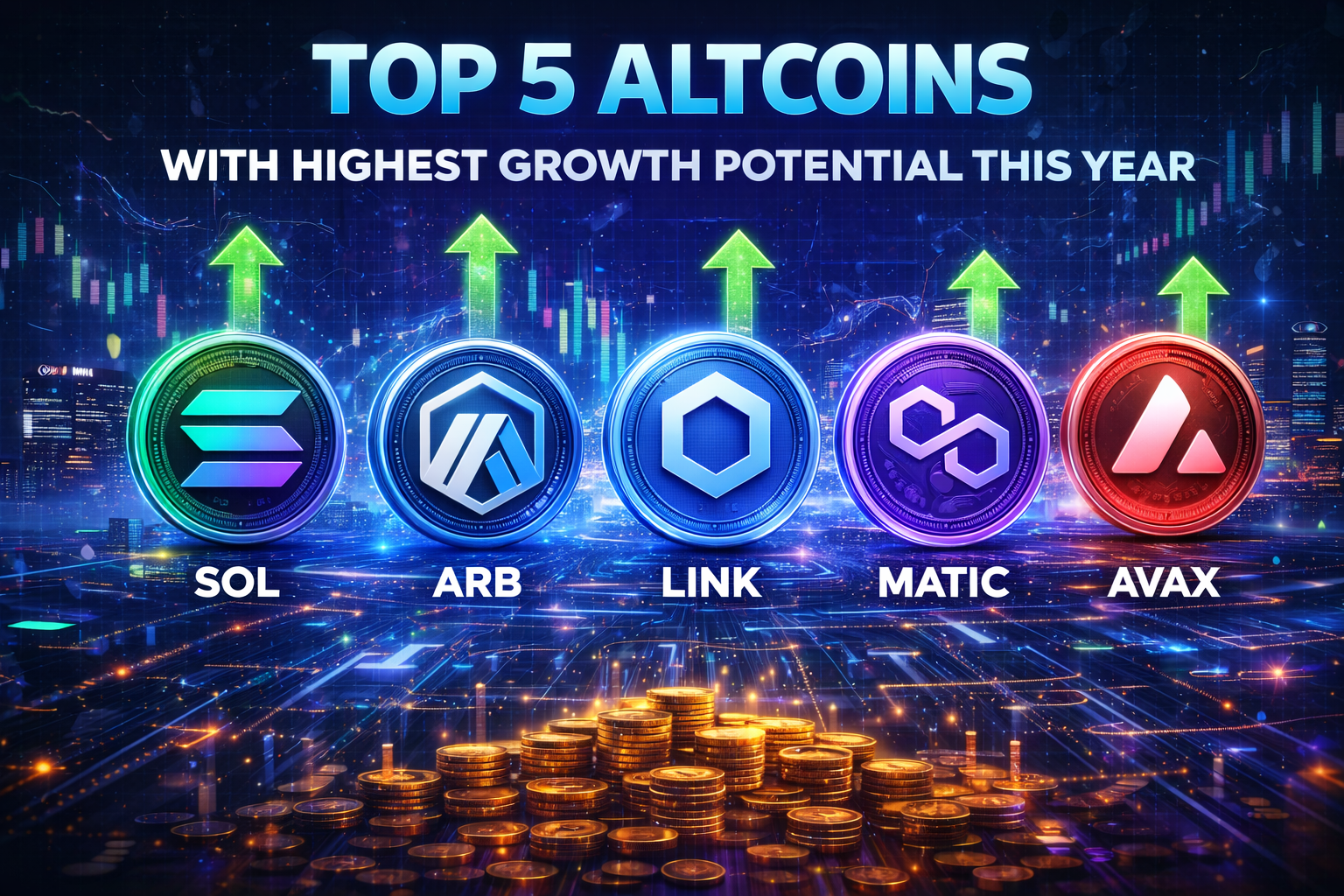
This year presents a unique environment shaped by technological advancements, growing institutional interest, and increasing real-world adoption of blockchain solutions. Below are five altcoins that stand out due to their technology, ecosystem growth, and market positioning. While no investment is guaranteed, these projects are widely regarded as having strong potential for growth.
1. Solana (SOL): High-Performance Blockchain Infrastructure
Solana has positioned itself as one of the leading high-performance blockchain platforms in the market. Known for its fast transaction speeds and low fees, Solana was designed to support large-scale decentralized applications without relying heavily on Layer 2 solutions.
One of Solana’s main strengths is its ability to process thousands of transactions per second while maintaining relatively low costs. This makes it particularly attractive for applications such as decentralized exchanges, NFT marketplaces, and blockchain-based games. Developers are drawn to Solana’s growing ecosystem, which continues to expand despite periods of network challenges in the past.
This year, improvements in network stability, tooling, and validator diversity are strengthening confidence in the platform. If adoption continues and the ecosystem matures, Solana could solidify its position as a core competitor to Ethereum in the smart contract space.
2. Arbitrum (ARB): Scaling Ethereum for Mass Adoption
Arbitrum is a leading Layer 2 scaling solution built on Ethereum. Rather than competing directly with Ethereum, it enhances Ethereum’s capabilities by offering faster transactions and significantly lower fees while inheriting Ethereum’s security.
The rise of Layer 2 solutions has become one of the most important trends in crypto, and Arbitrum is at the forefront of this movement. Many decentralized finance protocols have migrated or expanded to Arbitrum, attracted by reduced costs and improved user experience.
This year, continued Ethereum upgrades and increasing demand for scalable infrastructure could drive further growth for Arbitrum. As more users interact with decentralized applications without realizing they are using a Layer 2, Arbitrum’s role in the broader ecosystem may become increasingly critical.
3. Chainlink (LINK): The Backbone of Blockchain Data
Chainlink plays a unique and essential role in the crypto ecosystem by providing decentralized oracles. Oracles allow smart contracts to securely access off-chain data, such as price feeds, interest rates, and real-world events. Without reliable data inputs, many blockchain applications would simply not function.
Chainlink’s technology is widely adopted across decentralized finance, gaming, insurance, and enterprise blockchain solutions. Its expanding suite of services—including cross-chain interoperability and advanced data solutions—positions it as a foundational layer rather than a speculative application.
This year, the continued growth of real-world asset tokenization and institutional blockchain adoption could significantly increase demand for Chainlink’s services. As smart contracts become more integrated with traditional systems, Chainlink’s relevance and potential value may continue to rise.
4. Polygon (MATIC): Connecting Blockchains at Scale
Polygon has evolved from a simple scaling solution into a comprehensive blockchain interoperability platform. It offers a suite of tools that enable developers to build scalable, Ethereum-compatible blockchains with ease.
One of Polygon’s major advantages is its strong focus on enterprise adoption. Numerous global brands and institutions have explored or launched blockchain initiatives using Polygon’s infrastructure. This real-world engagement provides credibility and long-term growth potential.
This year, Polygon’s continued development of zero-knowledge technologies and modular blockchain solutions could further strengthen its ecosystem. By addressing scalability, interoperability, and sustainability, Polygon aims to position itself as a key bridge between Web2 and Web3 applications.
5. Avalanche (AVAX): Customizable Blockchain Networks
Avalanche stands out due to its unique approach to blockchain architecture. Instead of a single chain handling all activity, Avalanche allows developers to create customized blockchains—known as subnets—tailored to specific use cases.
This flexibility makes Avalanche attractive for institutions, gaming platforms, and enterprises that require specific compliance or performance features. Avalanche also offers fast finality and low transaction costs, making it competitive with other Layer 1 platforms.
This year, increased adoption of subnets and continued partnerships could drive growth for the Avalanche ecosystem. As blockchain use cases diversify, platforms that offer customization without sacrificing security may gain a significant advantage.
Key Factors Driving Altcoin Growth This Year
Several broader trends are shaping the potential growth of altcoins this year. First, scalability solutions are becoming essential as user activity increases. Projects that improve speed, reduce costs, and enhance usability are likely to attract both developers and users.
Second, institutional involvement is increasing. From tokenized assets to blockchain-based settlement systems, institutions are seeking reliable, scalable networks. Altcoins with strong security models and regulatory awareness may benefit disproportionately from this trend.
Finally, developer activity remains one of the most important indicators of long-term success. Ecosystems that continue to attract builders are more likely to produce innovative applications that drive sustained demand for their native tokens.
Risks and Considerations
While these altcoins show strong potential, investors should remain aware of the risks. Market volatility, regulatory uncertainty, and technological challenges can impact prices significantly. Additionally, competition within the crypto space is intense, and today’s leading projects must continue to innovate to maintain relevance.
Diversification, risk management, and ongoing research are essential when investing in altcoins. Rather than focusing solely on short-term price movements, understanding a project’s long-term vision and execution capability can lead to more informed decisions.
Conclusion: Opportunity Through Innovation
Altcoins continue to represent some of the most dynamic opportunities in the cryptocurrency market. The five projects highlighted—Solana, Arbitrum, Chainlink, Polygon, and Avalanche—each address critical challenges within the blockchain ecosystem and offer unique value propositions.
While no investment is without risk, these altcoins stand out due to their technology, adoption potential, and strategic positioning. As the crypto market evolves throughout the year, innovation and real-world utility are likely to be the primary drivers of sustainable growth.
For investors willing to navigate volatility and focus on fundamentals, this year could offer meaningful opportunities beyond the most established cryptocurrencies.
Deja una respuesta